TWO:Apart from legendary reputations, there is no name in the world¡¯s history more famous than that of Socrates, and in the history of philosophy there is none so famous. The only thinker that approaches him in celebrity is his own disciple Plato. Every one who has heard of Greece or Athens has heard of him. Every one who has heard of him knows that he was supremely good and great. Each successive generation has confirmed the reputed Delphic oracle that no man was wiser than Socrates. He, with one or two others, alone came near to realising the ideal of a Stoic sage. Christians deem it no irreverence to compare him with the Founder of their religion. If a few dissentient voices have broken the general unanimity, they have, whether consciously or not, been inspired by the Socratic principle that we should let no opinion pass unquestioned and unproved. Furthermore, it so happens that this wonderful figure is known even to the multitude by sight as well as by name. Busts, cameos, and engravings have made all familiar with the Silenus-like physiognomy, the thick lips, upturned nose, and prominent eyes which impressed themselves so strangely on the imagination of a race who are accused of having cared for nothing but physical beauty, because they rightly regarded it as the natural accompaniment of moral loveliness. Those who wish to discover what manner of mind lay hid beneath this uninviting109 exterior may easily satisfy their curiosity, for Socrates is personally better known than any other character of antiquity. Dr. Johnson himself is not a more familiar figure to the student of literature. Alone among classical worthies his table-talk has been preserved for us, and the art of memoir-writing seems to have been expressly created for his behoof.79 We can follow him into all sorts of company and test his behaviour in every variety of circumstances. He conversed with all classes and on all subjects of human interest, with artisans, artists, generals, statesmen, professors, and professional beauties. We meet him in the armourer¡¯s workshop, in the sculptor¡¯s studio, in the boudoirs of the demi-monde, in the banqueting-halls of flower-crowned and wine-flushed Athenian youth, combining the self-mastery of an Antisthenes with the plastic grace of an Aristippus; or, in graver moments, cheering his comrades during the disastrous retreat from Delium; upholding the sanctity of law, as President of the Assembly, against a delirious populace; confronting with invincible irony the oligarchic terrorists who held life and death in their hands; pleading not for himself, but for reason and justice, before a stupid and bigoted tribunal; and, in the last sad scene of all, exchanging Attic courtesies with the unwilling instrument of his death.80
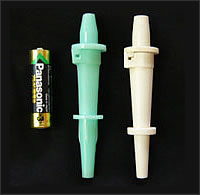
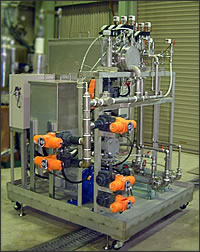
A hydrocyclone (liquid cyclone) injects treatment solution into stationary equipment to perform separation, classification, and concentration, and is an innovative separator with a very simple structure and no drive unit.
Structure of a hydrocyclone (liquid cyclone)
A suspension containing fine particles of several micrometers or more is supplied to a cylindrical container circumferentially at high speed. And as a result it starts to rotate and a centrifugal force is generated. At this time a gravitational acceleration of several tens of thousands of G is generated in the circumferential direction, and thus leading to fast sedimentation and concentration of the fine particles. The separated concentration can be freely selected by changing the supply rate (supply pressure and flow rate) and the flow ratio of the outlet. Our hydrocyclone (liquid cyclone) was designed and manufactured to classify and concentrate fine particles, and so has a small element.
THREE:"Now what does it mean?" he asked himself. "What game were they playing?"
- Equipment costs can be reduced.
- Operating costs can be reduced.
- Maintenance costs can be reduced.
- Any change in raw material and product can be easily addressed.
- Large amounts can be treated in a small area.
- Separation and cleaning are easy because of the simple structure.
- Simplified control
- This equipment can be operated in synchronization with external devices.
- Alarm and interlock mechanism.
THREE:A bell rang somewhere overhead, and Prout was summoned by a tall footman, who sniffed at him suspiciously as he led the way upstairs. In a magnificent wrap Leona Lalage sat. There was a cup of coffee before her. In a flash she saw exactly what had happened. Her hand did not shake now, the cigarette between her lips was steady. She had known that sooner or later this blow must fall.
- Classification and concentration for the manufacture of inorganic powder materials
- Classification of ceramic materials
- Removal of fine particles, including iron powder
- Removal of fine particles from pigments
- Removal of fine organic particles from solvents
- Separation of starch and yeast
- Removal of fine particles from high-temperature strong acid solutions
- Removal of fine particles from low-temperature solutions